





Instructions For Use Of Ultrasonic Non Contact Type Water Level Sensor
 Jul 19, 2024|
 Ultrasonic liquid level meter is a non contact type water level sensor measuring instrument. Since it does not come into direct contact with the liquid in the tower or tank, there is no liquid erosion and the failure rate is low. At the same time, when installing the instrument, there is no need to clean the tower or tank, and it can be directly installed in a good location outside without affecting industrial production. The characteristics of Ultrasonic liquid level meter, such as non-contact, few interference factors, low price and convenient use, make it widely used in liquid level measurement in the fields of petroleum, chemical industry, farmland water conservancy, etc., and it is especially widely used in water treatment and automatic control systems.
Instructions for use of Ultrasonic liquid level meter
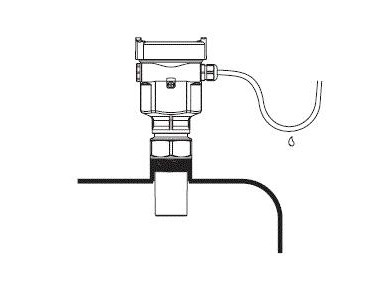
1. When installing ultrasonic non contact type water level sensor, pay attention to adjusting the height of Ultrasonic liquid level sensor from the liquid surface, which should not be too far or too close. If it is too close, it will enter the blind area of the probe and cannot be distinguished; if it is too far, the signal received by the probe is too weak, which is not conducive to accurate measurement.
2. Make sure that the probe surface is perpendicular to the measured liquid surface. At the same time, it is necessary to ensure that there are no obstacles in the area radiated by the ultrasonic beam emitted by the Ultrasonic liquid level meter probe, and the ladder, limit switch, pipeline, etc. in the tank should be avoided. Under normal circumstances, the diode of the transmitter will flash, and when the echo is received, a clicking sound can be heard near the sensor.
3. Ultrasonic waves are not very resistant to electromagnetic interference and are easily affected by nearby electrical equipment. Therefore, the signal line of the non contact type water level sensor should use an independent threading tube and stay away from lighting lines and power lines. To ensure good signal shielding, the threading tube should use a conductive steel pipe, and the shielding layer should be grounded at a single point to avoid the potential difference of the loop from interfering with the instrument.
4. If the signal line, especially the joint, is damp, it will also cause signal disorder, so the signal line should be kept dry. When the signal line must go through the cable trench, the signal line should be laid on the cable trench bracket.
5. To prevent poor contact of the signal line of the non contact type water level sensor, try not to leave a joint in the middle of the signal line. If the joint is unavoidable, it should be welded to reduce hidden dangers. At the same time, there should be no looseness at the crimping of the terminal, otherwise the contact resistance will be large.